
Public Safety, Identification, and the Risks of Unmarked Power
Editor’s Note
This article does not examine immigration policy, enforcement priorities, or the legitimacy of federal law enforcement agencies. Instead, it explores a narrower and more structural question: how democratic societies maintain public trust and public safety when the visible markers of official authority are minimized. The focus here is not intent, but institutional design—and the consequences that design can carry.
The Democratic Compact of Authority
In democratic systems, the state is granted a limited monopoly on the use of force. That authority is not unconditional. It rests on a long-standing civic compact: individuals cede certain freedoms in exchange for protection, order, and the rule of law.
When force is exercised in public spaces, this compact depends on two core conditions: authority must be verifiable and accountable.
Uniforms, badges, marked vehicles, and clear identification have historically served a simple purpose. They allow ordinary people—often under stress—to distinguish lawful authority from criminal impersonation. Compliance, in this framework, is not blind obedience but informed recognition.
This compact does not eliminate abuse. But it reduces ambiguity. And ambiguity is where public trust erodes fastest.
The Verification Gap
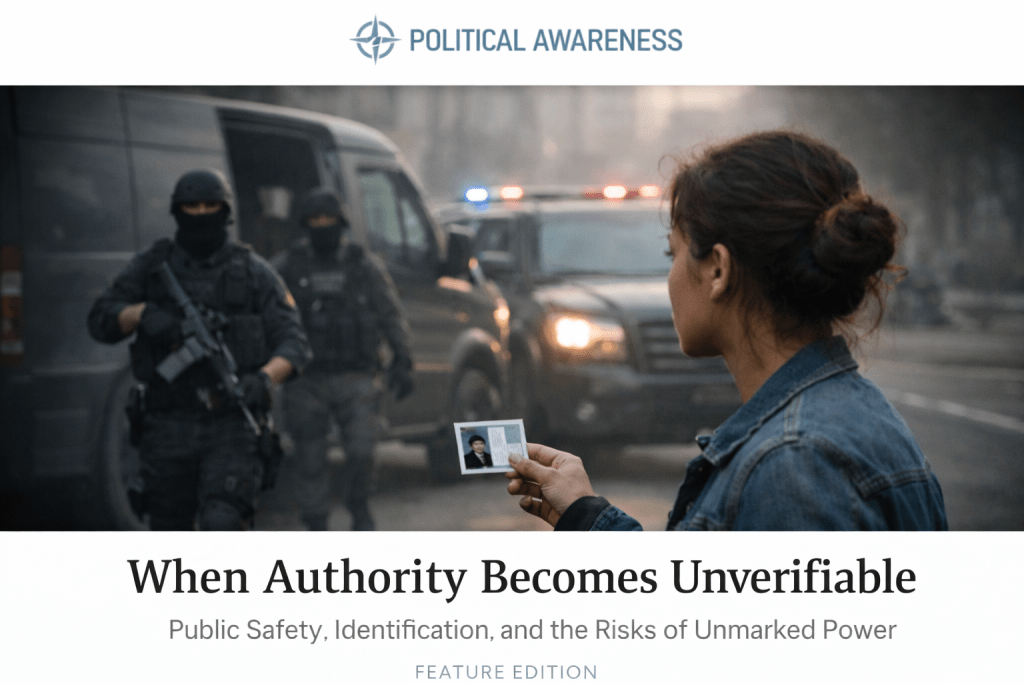
In recent years, some federal enforcement operations have relied on elements that reduce immediate public verification: unmarked vehicles, obscured faces, and limited visible
identification during initial contact. These measures are often justified on grounds of officer safety or operational security.
From an institutional perspective, however, such practices introduce a verification gap. When the visual cues of authority are muted, civilians are left to assess legitimacy in real time, often under pressure and without context.
This gap is not ideological. It is mechanical. And like any design choice, it carries tradeoffs.
Impersonation Is a Known Risk, Not a Hypothetical One
Across jurisdictions and decades, impersonation of authority has been a recurring criminal tactic. Fake utility workers, fraudulent police officers, and uniformed impostors exploit one central vulnerability: people are conditioned to comply when authority appears plausible.
Public safety institutions are typically designed to minimize this risk, not amplify it. Clear identifiers exist not only to protect civilians, but also to protect legitimate officers from being confused with bad actors.
When those identifiers are absent or unclear, the burden of discernment shifts to the individual—often in moments when hesitation itself may feel dangerous.
When Verification Itself Feels Unsafe
Historically, asking a law enforcement officer to identify themselves or state their authority has traditionally not been treated as lawful provocation. It has been understood as a normal feature of civic interaction in a free society.
However, public accounts and widely circulated recordings in recent years have contributed to a growing perception that attempts to question or verify authority can escalate quickly. In some encounters, requests for identification appear to be interpreted as resistance rather than due diligence.
Whether this perception is universal or episodic is less important than its effect. When people believe that asking “who are you?” may itself carry risk, verification ceases to function as a safeguard.
At that point, compliance is no longer anchored in trust, but in fear.
Asymmetric Risk and Vulnerability
Verification gaps do not affect all populations equally. Young people, individuals who are alone, and those unfamiliar with legal processes face heightened risk when authority is ambiguous. For them, the cost of guessing wrong—either by complying with an impostor or questioning a legitimate officer—can be severe.
Other factors—including race, ethnicity, gender, and immigration status—may further shape vulnerability, but the focus here is on structural ambiguity rather than demographic outcomes.
This asymmetry matters. Democratic systems are evaluated not by how they function for the confident and informed, but by how they protect the vulnerable in moments of uncertainty.
The Institutional Tradeoff
Institutions routinely balance competing priorities: officer safety, operational effectiveness, visibility, and accountability. The presence of tradeoffs does not imply malice or misconduct. It reflects the complexity of enforcement in public space.
The question raised here is not whether enforcement should occur, but how it should be recognized.
At what point does operational opacity undermine the very legitimacy that grants authority its power? And how much ambiguity can a free society tolerate before lawful force becomes indistinguishable, in practice, from coercion?
The Question That Remains
The danger is not that authority is questioned. Democracies depend on questioning. The danger is when questioning authority becomes indistinguishable from defiance.
If the public cannot safely verify who is acting under color of law, the civic compact frays—not because people reject authority, but because they can no longer recognize it.
That is not a partisan concern. It is a design problem. And design problems, left unexamined, tend to fail at the worst possible moment.
Political Awareness — Standard Footer
The modern internet is not designed to deliver truth. It is designed to maximize attention, reinforce existing beliefs, and keep users engaged for as long as possible. Accuracy, context, and proportion are often secondary to immediacy and emotional response.
Political Awareness exists to slow that process down.
Our work focuses on examining primary sources, historical patterns, and institutional incentives—separating what is popular from what is verifiable, and what is emotionally resonant from what is structurally true. An informed democracy does not depend on consensus. It depends on literacy, skepticism, and sustained civic engagement.
Note: Political Awareness never authorizes its published communication on behalf of any candidate or their committees.
Note: This content was created with AI assistance and reviewed by Political Awareness Super PAC staff. Paid for by Political Awareness Super PAC. Not authorized by any candidate or candidate’s committee.
Leave a Reply