
Key Details
-
Session Duration: The 119th Congress will last from January 3, 2025, to January 3, 2027.
-
Party Control: The Republican Party holds a 220–215 majority in the House and a 53–47 majority in the Senate. This marks the first time since 2019 that Republicans have controlled both chambers of Congress.
-
Leadership: Mike Johnson was re-elected as Speaker of the House, and John Thune was elected as the new Senate Republican leader, succeeding Mitch McConnell.
The Legislative Branch, established under Article I of the U.S. Constitution, is made up of two main parts: the House of Representatives and the Senate, together known as the United States Congress. According to the Constitution, Congress has the exclusive power to create laws, declare war, approve or reject many presidential appointments, and conduct investigations.
House of Representatives:
This chamber has 435 members, with seats distributed among the 50 states based on their population. There are also 6 non-voting members representing the District of Columbia, Puerto Rico, and four U.S. territories: American Samoa, Guam, the U.S. Virgin Islands, and the Northern Mariana Islands. The House is led by the Speaker of the House, who is chosen by the Representatives and is third in line for presidential succession.
House members are elected every two years. To qualify, they must be at least 25 years old, a U.S. citizen for at least seven years, and live in the state they represent (though not necessarily in the district).
The House has unique powers, including starting revenue bills, impeaching federal officials, and choosing the President if no candidate wins a majority in the Electoral College.
Senate:
The Senate has 100 members, with two Senators from each state. Before the 17th Amendment in 1913, Senators were chosen by state legislatures, but now they are elected directly by the people for six-year terms. Senate terms are staggered, so about one-third of the Senate faces election every two years. Senators must be at least 30 years old, a U.S. citizen for nine years, and residents of their state.
The Vice President of the U.S. serves as the President of the Senate and can cast tie-breaking votes. The Senate has the exclusive authority to confirm presidential appointments and ratify treaties, with the exception of appointments for Vice President and trade treaties, which require House approval. The Senate also conducts impeachment trials for federal officials.
For legislation to become law, both chambers must pass the same bill. If the President vetoes it, Congress can override the veto with a two-thirds vote in each chamber.
The Legislative Process:
A bill can be introduced by anyone, but only members of Congress can officially introduce legislation. Many bills, like the federal budget, are introduced at the President’s request. Once introduced, the bill goes to a committee for review. Committees are specialized groups—there are 17 Senate committees with 70 subcommittees, and 23 House committees with 104 subcommittees—that oversee different policy areas.
In subcommittees, the bill is examined, amended, or rejected. If approved, it moves to the full committee, where hearings are held, involving experts and stakeholders who provide testimony. If the full committee approves the bill, it goes to the floor for debate and voting. The House has strict rules for debate; Senators, however, can speak for as long as they want and introduce amendments, sometimes using a filibuster to delay a vote. Ending a filibuster requires 60 Senators to invoke cloture.
A bill must pass both chambers before reaching the President. When both chambers pass different versions, a Conference Committee works out a final version. This is then voted on again, and if approved, it is signed by the Speaker of the House and the Senate President before being sent to the President.
The President has several options: sign the bill into law, veto it, or take no action. If vetoed, Congress can override the veto with a two-thirds majority. If the President takes no action while Congress is in session, the bill becomes law; if Congress adjourns, the bill dies in what’s called a pocket veto.
Powers of Congress:
Congress holds significant authority, as all legislative power resides with it. It can create and amend laws, approve budgets, and raise revenue through taxes and tariffs. It can also borrow money if needed. Both chambers have investigatory powers, including holding hearings and compelling testimony, with refusal to cooperate potentially leading to contempt charges.
The Senate alone has special powers: ratifying treaties with a two-thirds vote and confirming presidential appointments. It also has the authority to declare war.
Government Oversight:
Congress monitors the executive branch to ensure laws are properly implemented and that government agencies operate efficiently. This oversight includes conducting hearings through dedicated committees, and audits by the Government Accountability Office (GAO), which reviews the effectiveness of government spending. Additionally, Inspectors General in each agency regularly audit their respective agencies to ensure accountability.
This system of checks and balances helps maintain the separation of powers and ensures that no branch becomes too powerful.
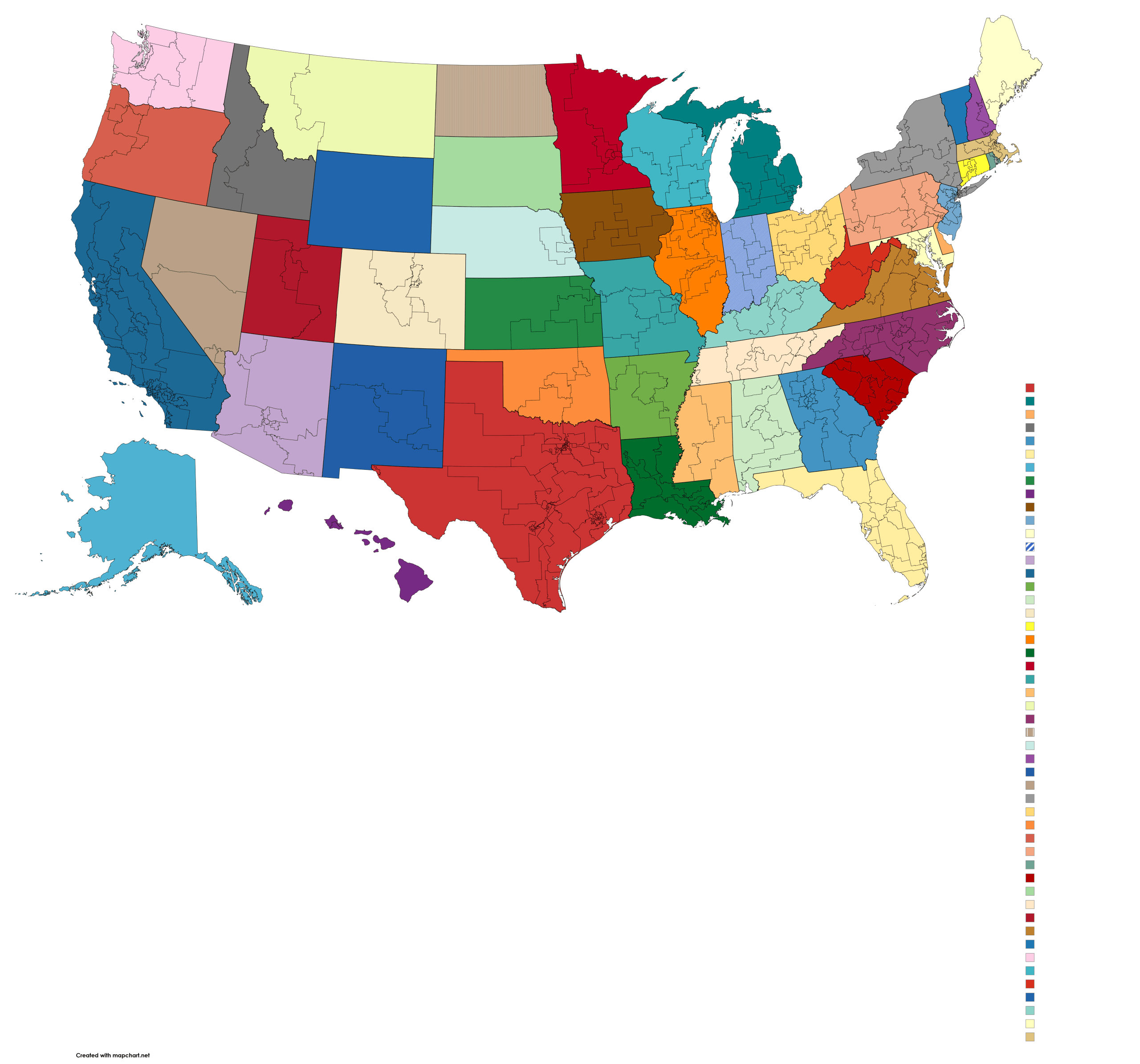
National 119th Congressional District Map
This map depicts congressional district boundaries in effect for the 119th Congress of the United States. The map also includes a listing of all districts of the 119th Congress, as of January 1, 2026.
Find your House Representative
Search for your Congressional District and Representative by ZIP Code.
119th Congressional District Map
119th Congress legislative calendar
-
December 1-4, 9-12, 15-18: Both chambers in session.
-
January 6-9, 12-15: Both chambers in session.
-
January 5, 16, 26-30: Only the Senate in session.
-
May 12-15, 18-21: Both chambers in session.
-
June 2-5, 8-11, 23-26: Both chambers in session.
-
July 13-16, 20-23: Both chambers in session.
-
September 14-17, 22-25, 28-30: Both chambers in session.
-
October 31: Both chambers in session.
-
November 1-4: Both chambers in session.
-
December 1-4, 9-12, 15-18: Both chambers in session.
For a complete list of dates and sessions, please refer to the official congressional calendars provided by the Library of Congress and Congressman Steve Scalise’s office

Note: Political Awareness never authorizes its published communication on behalf of any candidate or their committees.